You have the copy written, the photos picked and a logo that finally looks right. Then the printer asks which fold you want, and it turns out that one answer decides the panel sizes, the file setup, the paper and part of the price. Choosing between the types of brochure folds is less about looks than about how much you have to say and where the brochure is going to end up.
This guide walks through each fold with real dimensions, then covers the paper and file decisions that change with it. If you already know your fold and want the job quoted, our page on brochure printing in Markham covers sizes, stocks and finishes.
What Are the Main Types of Brochure Folds?
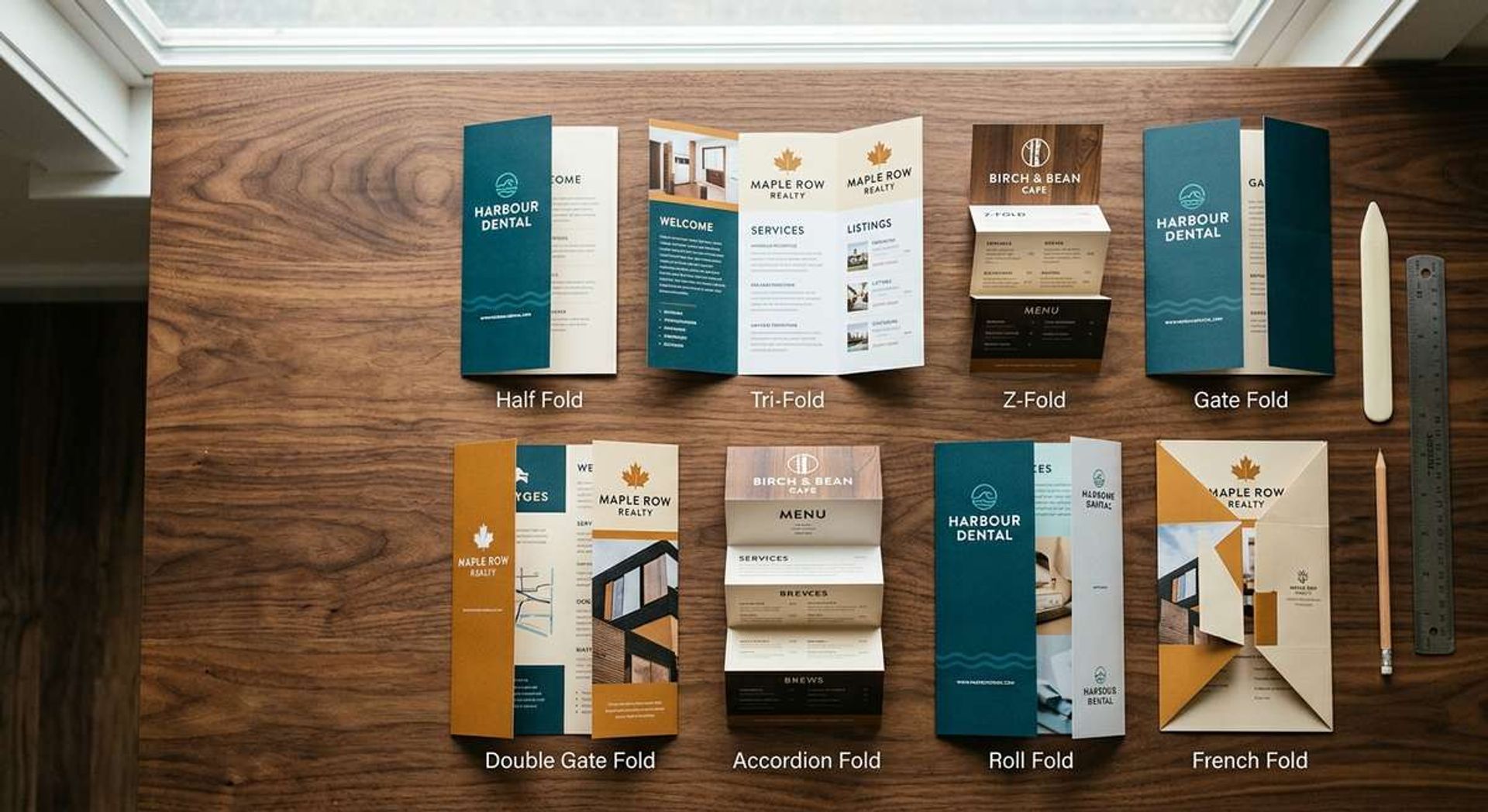
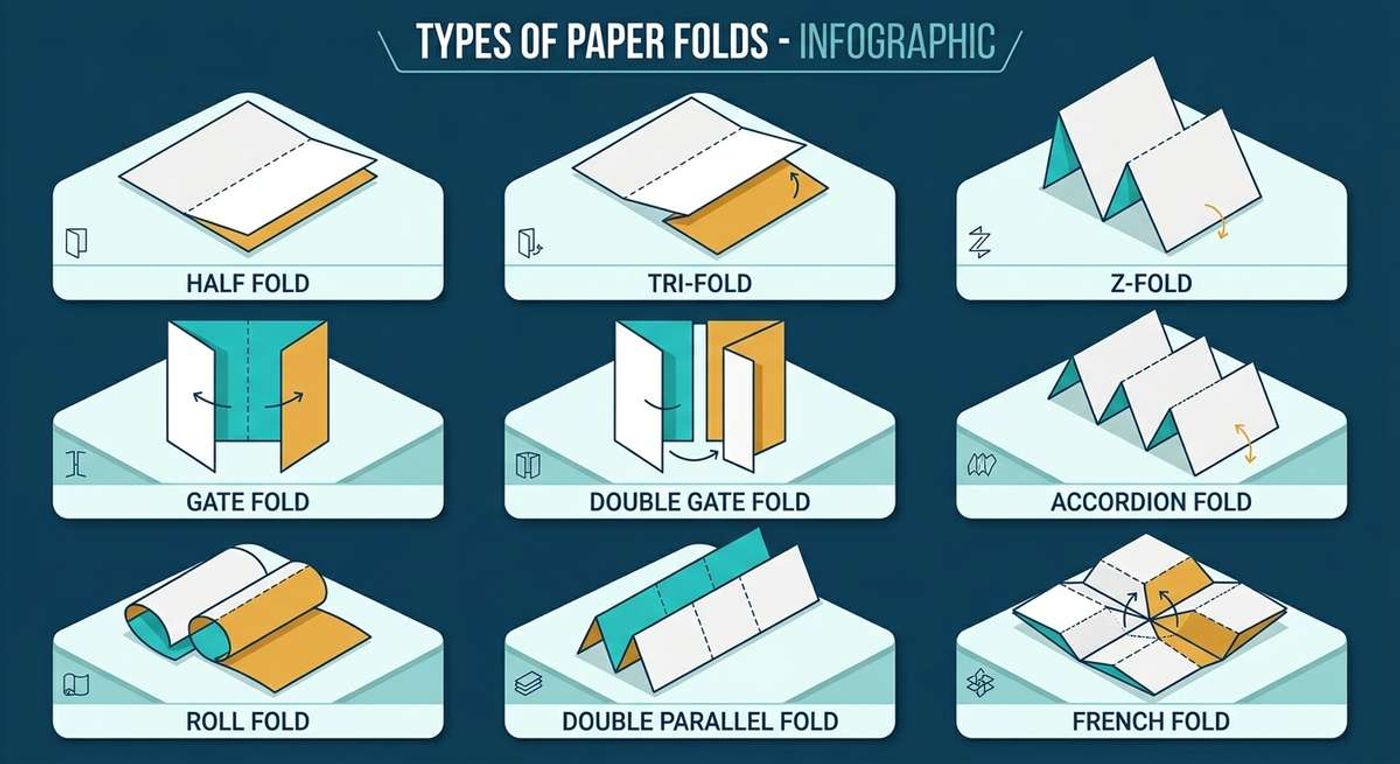
The main types of brochure folds are the half fold (bi-fold), tri-fold, Z-fold, gate fold, double gate fold, accordion fold, roll fold, double parallel fold and French fold. Each one divides a single printed sheet into panels in a different way. The tri-fold is the most common. Folds with more panels hold more content, but they need lighter paper and more careful file setup.
Here is how they compare on standard North American sheets. Finished sizes are approximate, because some panels are trimmed slightly narrower so the brochure closes flat.
Panels, Flat Size and Finished Size: Brochure Terms in Plain Language
A panel is one section of the sheet between two folds, counted on one side. A tri-fold has three panels on each side, so six in total. Printers sometimes call these pages. The flat size is the sheet before folding, and it is what your design file is built at. The finished size is what the reader actually holds. Scoring means pressing a crease line into the paper before it is folded, so heavier stock bends cleanly instead of cracking.
How to Choose the Right Fold for Your Brochure
Match the Fold to How Much You Have to Say
Count your content before you pick a format. If your message fits comfortably on one or two sides of a sheet, you may not need a fold at all, and a flat flyer is simpler to produce. A half fold gives you four panels: a cover, a two-panel inside spread and a back for contact details. Tri-folds and Z-folds give you six, which suits a service overview with three to five sections. Eight-panel folds such as the accordion, roll and double parallel handle a full list of services or a detailed process.
Once you are past about eight panels, a folded sheet gets bulky and hard to navigate. That is usually the point where one of the other different types of brochures, a stapled booklet, reads better. Booklets keep pages in a fixed order and hold up when they are passed around a meeting table.
Match the Fold to Where the Brochure Ends Up
In a rack at a clinic, hotel lobby or community centre. A Letter tri-fold finishes at about 3.67 x 8.5 inches, which slides into the 4 x 9 inch pockets most brochure racks are built for. A Letter half fold is too wide for most racks. Measure the actual holder before you commit, because rack sizes vary.
On a counter, at a trade show booth or across a meeting table. The cover does most of the work here. A half fold gives you the largest cover for a single photo, and a gate fold opens in stages, which lets you walk someone through a proposal panel by panel.
Mailed without an envelope. The brochure becomes a self-mailer. A Letter tri-fold, at about 93 x 216 mm folded, sits within Canada Post's standard Lettermail dimensions as long as its weight and thickness also stay within the limits. It has to be sealed. Canada Post's guidance on self-mailers describes adhesive tabs or glue spots, with the side edges sealed as well as the top for the best processing. Leave one outside panel clear for the address and postage, and confirm current requirements before you print.
Classic Brochure Folds: Half Fold, Tri-Fold and Z-Fold
Half Fold (Bi-Fold) Brochures
One fold down the middle gives you four panels. A Letter sheet folds to 5.5 x 8.5 inches, and a Tabloid sheet (11 x 17) folds to a full 8.5 x 11. The inside opens into two large panels side by side, which suits a big photo, a floor plan or a two-column comparison. It works well for restaurant menus, event programs and simple product sheets. The trade-off is width: it will not fit most racks.
Tri-Fold Brochures and the Narrower Inside Panel
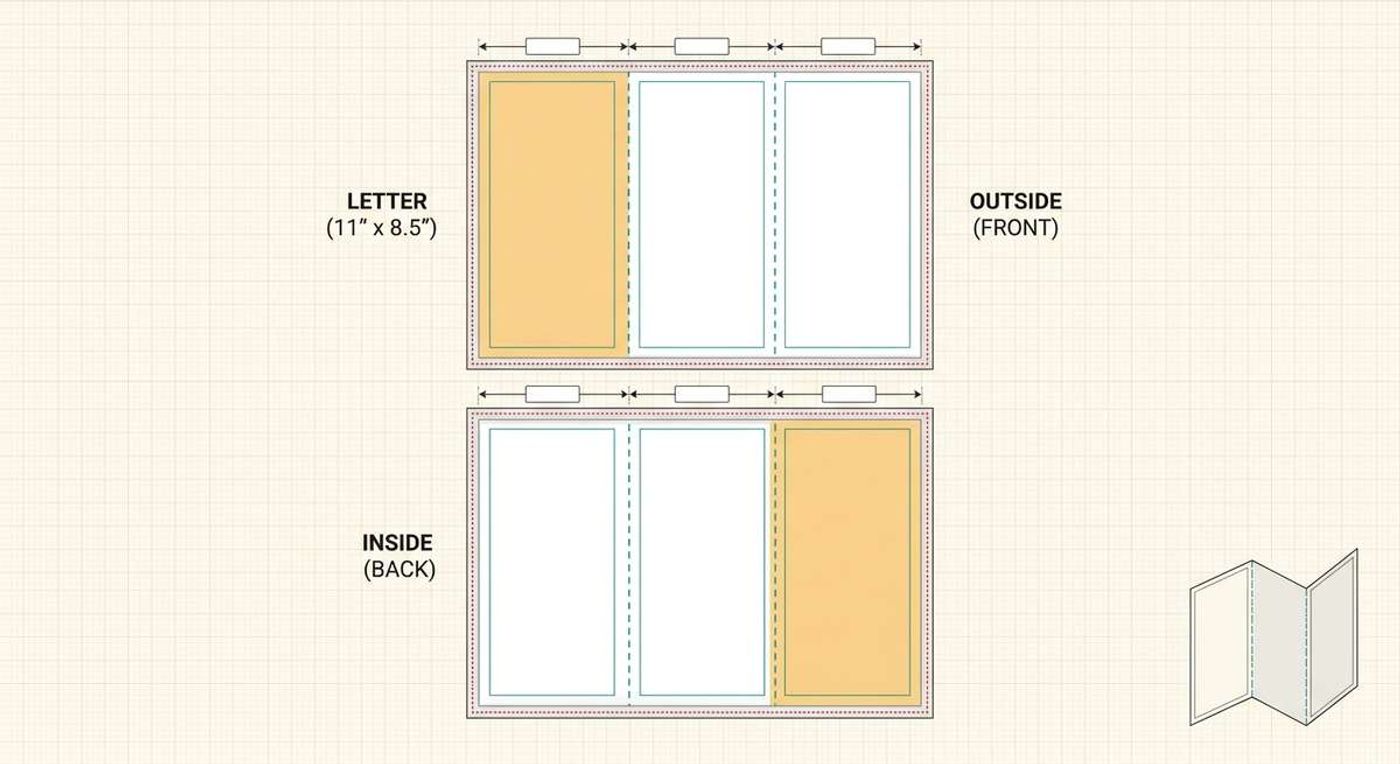
Also called a letter fold or C-fold, the tri-fold is the most common brochure format. The sheet folds into thirds, and the two outer panels wrap over each other, so the finished piece has a front cover, a back panel and a flap that tucks inside.
The detail most templates get wrong is that the three panels are not equal. The panel that folds inward has to be slightly narrower, usually by about 1/16 inch, or it pushes against the fold and the brochure will not close flat. On a Letter sheet that works out to roughly 3.6875, 3.6875 and 3.625 inches. Our guide to standard flyer sizes explains why the file is built at flat size rather than as three separate panels.
Reading order matters too. People see the front cover first, then the tucked-in flap alongside the inside left panel, then the full three-panel spread. The back panel is read last, which makes it the natural home for your address, phone number and a small map. The flap is the second thing anyone sees, so it is a good place for your strongest offer or a short summary of what you do.
Z-Fold Brochures vs Tri-Folds
A Z-fold also has six panels on a Letter sheet, but the panels fold back and forth like the letter Z instead of wrapping inward. Because nothing tucks inside, all three panels are the same width, about 3.67 inches each on Letter. That changes how it reads. A Z-fold opens in one motion into a continuous strip, so it suits sequential content like a timeline, a treatment process or setup instructions, and a photo can run across the full inside width.
Gate Fold Brochures for a Bigger Reveal
Standard Gate Fold
Two outer flaps fold in to meet at the centre, like a pair of doors, and open onto a centre panel twice their width. On a Tabloid sheet the centre panel is 8.5 inches wide and the finished brochure is 8.5 x 11. The flaps are made a little narrower than half the centre panel, typically by 1/16 to 1/8 inch, so they meet without rubbing.
Gate folds suit anything built around one big reveal: a new property listing, a product launch, an event invitation. One design warning: do not run a line of type or a logo across the seam where the two flaps meet on the cover. Folding tolerances mean the two halves rarely line up perfectly, and the misalignment is the first thing people notice.
Double Gate Fold
A double gate is a gate fold folded in half once more, giving eight panels. From a Tabloid sheet it finishes at about 4.25 x 11 inches. You get a cover, a first reveal and then a four-panel spread inside, which suits premium presentations and property feature sheets. It usually needs scoring.
Accordion, Roll and Other Multi-Panel Brochure Folds
When six panels are not enough, these folds give you eight or more from a single sheet. All of them work best on lighter paper, since every extra layer adds bulk at the fold.
Accordion Fold Brochures
An accordion is a Z-fold with more panels, most often four per side on a Legal sheet (8.5 x 14), which folds to 3.5 x 8.5 inches. The panels are equal width and zigzag open like a fan. Use it for event schedules, walking maps and anything the reader should see laid out end to end. Five- and six-panel versions are possible on longer sheets.
Roll Fold Brochures
A roll fold rolls the panels inward, one inside the next, from a sheet divided into four or more panels. Each panel that rolls inside has to be slightly narrower than the one before it, usually by about 1/16 inch, so it clears the fold. The result reveals content one panel at a time, which works for a step-by-step guide or a list of services you want read in a set order.
Double Parallel Fold Brochures
Fold the sheet in half, then in half again in the same direction, and you have eight panels. A Legal sheet finishes at about 3.5 x 8.5 inches, and a Tabloid sheet at about 4.25 x 11. The two panels that end up inside are trimmed slightly narrower. They are common for maps, tourism guides and product listings.
French Fold and Right-Angle Folds
A French fold folds the sheet in half one way, then in half again at a right angle. A Tabloid sheet finishes at 5.5 x 8.5 inches. Because the final unfold opens the whole sheet, the inside can work as a small poster, a full-page map or a floor plan, while the outside panels carry the cover and a summary. One of the two folds always runs against the paper grain, so on heavier stock this fold needs scoring.
Custom and Creative Brochure Folds
Beyond these, there are stepped accordions with staggered panel widths, combination folds that pair a half fold with a tri-fold, and die-cut shapes. They make a memorable piece, but often need a custom template, hand finishing or a cutting die, which adds cost and time. If you have one in mind, bring a paper mock-up when you ask for a quote.
Paper Stock for Folded Brochures
Text Weight vs Cover Weight Brochure Paper
Brochure paper comes in two families. Text weight is flexible, magazine-like paper. Cover weight is heavier card. Pound figures are not comparable across the two, so 80 lb cover is much heavier than 100 lb text. Rough equivalents:
- 80 lb text, about 118 gsm. Light and easy to fold. Good for high-quantity handouts and folds with many panels.
- 100 lb text, about 148 gsm. The everyday weight for tri-folds and Z-folds. It feels substantial and still folds cleanly.
- 80 lb cover, about 216 gsm. Stiff enough for a half-fold menu or a gate fold that gets handled a lot. Needs scoring.
- 100 lb cover, about 270 gsm. A premium feel for a half fold or presentation piece. Needs scoring, and is too thick for multi-panel folds.
The rule of thumb is simple: the more panels, the lighter the paper. A four-panel roll fold on cover stock bulges at the folds and will not stay closed.
Scoring: Why Heavy Brochure Stock Cracks at the Fold
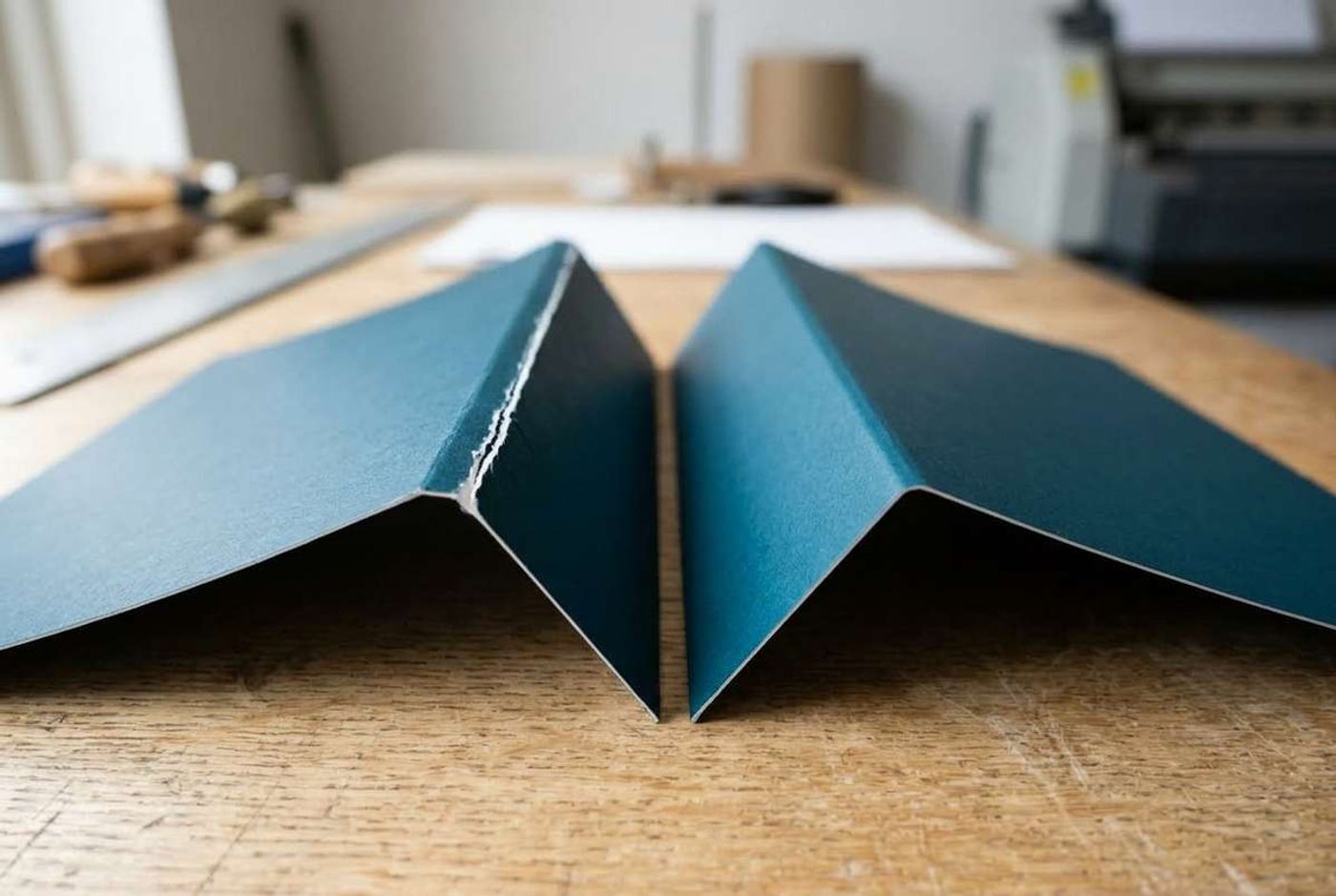
Fold a thick, coated sheet without preparation and the outer surface splits along the crease, leaving a white line through your colour. It is most visible on dark backgrounds and when the fold runs against the paper grain. Scoring presses a crease into the sheet before folding so it bends cleanly. Most cover weight brochures need it. If your design has solid colour across a fold line, mention it at quote stage so the paper and scoring can be planned together.
Gloss or Matte for a Folded Brochure
Gloss makes photographs look vivid, which suits real estate and restaurant brochures. Matte is easier to read under bright lights and takes a pen, which helps when staff write notes on a brochure before handing it over. Our business card paper stock guide covers coated and uncoated paper in more detail, and the same rules apply to brochures.
Brochure Artwork Setup for Folded Designs
Build the File at Flat Size, Panels in Imposed Order
Set up one document at the flat sheet size with two pages, outside and inside. Do not send three separate panel files. On a tri-fold, the outside page runs, from left to right, the tuck-in flap, the back panel and the front cover. The inside page holds the three inside panels, with the narrow tuck-in panel on the right. Ask us for the panel measurements for your fold before you start, rather than dividing the sheet into equal thirds.
Bleed, Safe Area and Fold Lines
Add 0.125 inch of bleed, meaning background that extends past the cut, to the four outer edges of the flat sheet, never to the fold lines. Keep text and logos at least 0.125 inch inside the trim, and treat every fold line as a margin too, with about 0.125 to 0.25 inch of clear space on either side for text. Photos can cross a fold, but avoid putting faces, small type or a phone number right on the crease. Set colour to CMYK and place images at 300 DPI at their printed size.
Common Brochure Folding Mistakes
Equal tri-fold panels. The tuck-in panel has to be narrower. Equal thirds produce a brochure that springs open.
Heavy stock on a multi-panel fold. Cover weight on a roll or accordion fold bulges and cracks. Go lighter as the panel count goes up.
The main offer on the back panel. It is read last, if at all. Put the offer on the cover or the tuck-in flap.
Type across a gate fold seam. It will not line up. Keep each flap's cover design self-contained.
Approving from a flat PDF. Print the proof at full size, fold it by hand and read it the way a customer would.
Printing Folded Brochures in Markham
When you request a quote, tell us the fold, the flat size, the quantity, your paper preference, whether your artwork is ready and when you need the brochures. If you are not sure which fold fits, send the content and a line about how the brochure will be handed out, and we will suggest a format. We have been printing for Markham businesses for over 30 years, and a short conversation before design starts saves the most time. Request a quote and we will reply within one business day.
Folded Brochures on a Short Deadline
If the event is this week, the simplest path is a tri-fold, Z-fold or half fold on a standard text weight stock. Specialty folds, scored cover stock and creative formats add production steps, so if time is tight, plan them for the next print run. Our rush printing page explains how short turnarounds work.